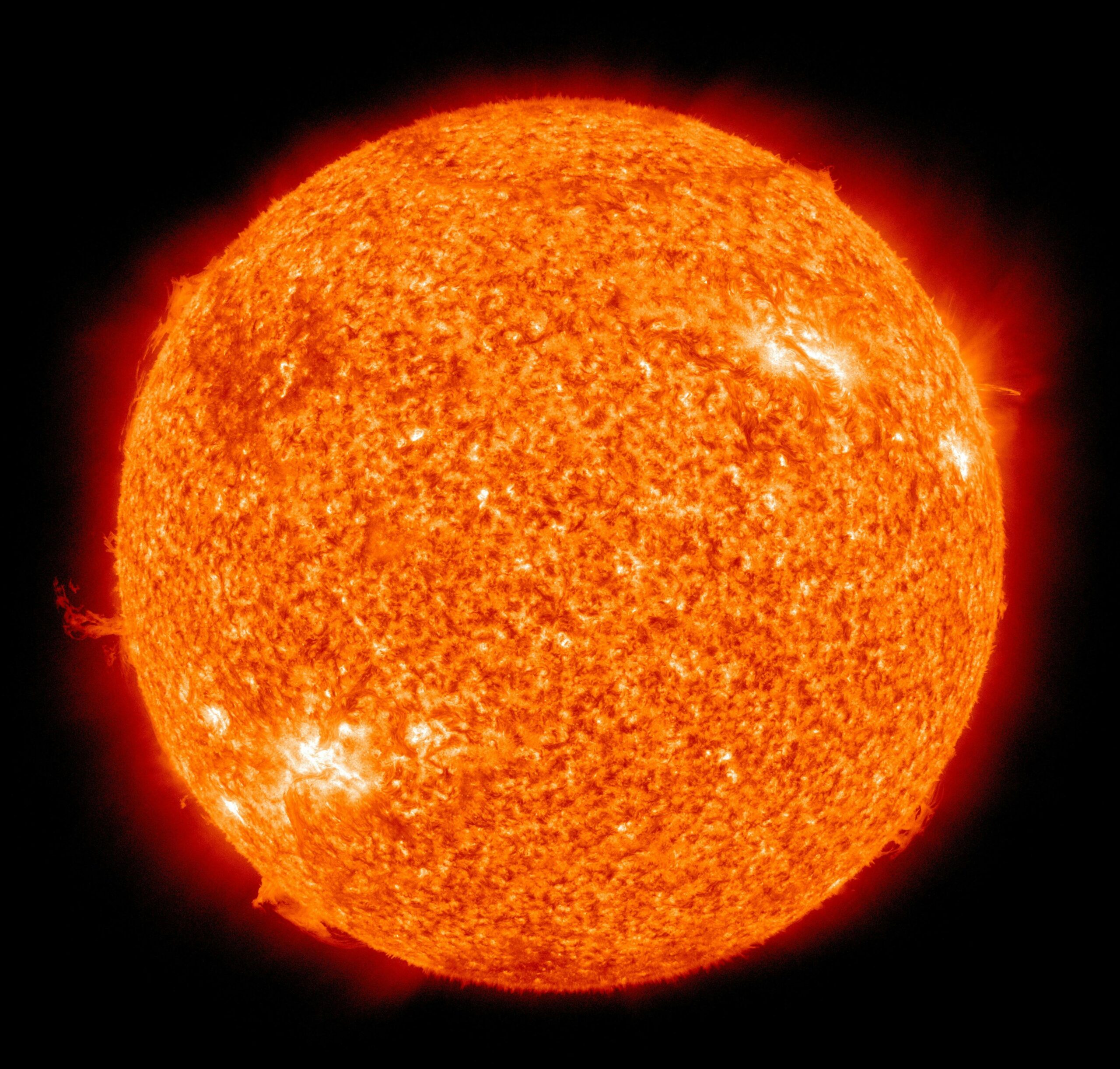
The solar wind is a continuous stream of charged particles ejected from the upper atmosphere of the Sun.
It mostly consists of electrons and protons with energies usually between 10 and 100 keV. These particles can escape the Sun’s gravity because of their high kinetic energy and the high temperature of the corona and assisted by the low pressure in the interplanetary space. The stream of emitted particles varies in temperature and speed over time. The solar wind creates a vast bubble of such charged particles that includes the Solar System and extends beyond it. This is called the Heliosphere. All the planets and other bodies in the Solar system and inside this Heliosphere.
It was the British astronomer Richard Carrington, who observed that a sudden outburst of energy from the Sun’s atmosphere is followed by a geomagnetic storm on the earth. He, therefore, proposed that, there must be something that is coming from the Sun and reaching the Earth. George Fitzgerald later suggested that, matter was being regularly accelerated away from the Sun and was reaching the Earth after several days. The ideas of Fitzgerald and others were further developed by the Norwegian physicist Birkeland. He observed that the Auroral activities are nearly uninterrupted. As these displays and other geomagnetic activity were being produced by particles from the Sun, he concluded that the Earth was being continually hit by energetic charged particles emitted by the Sun. Birkeland also mentioned about the electrical nature of the solar wind, pointing out that, they are neither exclusively negative nor positive rays, but of both kinds. In other words, the solar wind consists of both negative electrons and positive ions. Also in the 1950s, a German scientist named Ludwig Biermann observed that, no matter whether a comet is headed towards or away from the Sun, its tail always points away from the Sun. Biermann postulated that this happens because the Sun emits a steady stream of particles that pushes the comet’s tail away.
Parker showed that even though the Sun’s corona is strongly attracted by solar gravity, it is such a good conductor of heat that it is still very hot at large distances. Since gravity weakens as distance from the Sun increases, the outer coronal atmosphere escapes supersonically into interstellar space. Opposition to Parker’s hypothesis on the solar wind was strong. The paper he submitted to the Astrophysical Journal in 1958 was rejected by two reviewers. It was saved by the editor Subrahmanyan Chandrasekhar (who later received the 1983 Nobel Prize in physics).
However, detailed calculations showed that only thermal energy cannot provide enough velocity to the particles to escape the gravitational pull of the Sun. It is the additional electric field created by the accelerating electrons that fills the deficit.
Read the article and attempt this simple Quiz on Solar Wind
Components:
There are primarily two kinds of solar winds, viz. the slow solar wind and the fast solar wind. The slow solar wind has a velocity of about 400 km/s, while the fast solar wind has a typical velocity of 750 km/s. at any time, the solar wind particle velocity remains near one of these two. Further, the slow solar wind has density is typically more than twice as dense and more variable in intensity than the fast solar wind. The slow solar wind originates from the Coronal region of the Sun while the fast winds originate from the coronal hole. The coronal holes are the funnel-like regions of open field lines in the Sun’s magnetic field. These are more abundant near the poles of the Sun.
During the time of solar minimum, the sources of the slow winds remains confined near the equatorial region of the Sun. This region is known as the ‘Streamer Belt’ and extends up to 35° on both sides of the solar equator. The fast winds blow from the Poles. As the Sun turns more active, the area covered by the Slow wind sources extends towards the poles and at the Solar Maximum activity period, most of the Sun’s surface emit slow winds.
The particle density of the solar wind is around 10 particles /m³ at the distance of the Earth, i.e. 1 AU from the earth. Then, the total number of particles carried away from the Sun by the solar wind becomes about 1.3×10^36 per second. If we consider the particles as Protons, then the total mass loss is 6.7 billion tons per hour. So, the mass loss each year is about (2–3)×10−14 solar masses. However, only about 0.01% of the Sun’s total mass has been lost through the solar wind.
This plasma in the solar wind are tightly coupled with the Magnetic field of the Sun. When these plasma move away from the Sun, they also brings with them, the magnetic force lines. This is called the Interplanetary Magnetic Field (IMF).
These charged plasma and the associated magnetic field fills up the interplanetary space. As they move out of the sun, due to the motion of the Sun, they spread out in a curved path, due to what is called as the ‘Garden hose effect’. These charges and fields engulfs the whole Solar system and a very large space even beyond it.
This solar wind interacts with the Geomagnetic field of the earth and also interacts with the other planets. This causes the interplanetary conditions to vary electrically and magnetically and gives rise to various phenomena, which defines the Space Weather.
Sometimes, solar winds are enhanced with other solar phenomena, like the coronal mass ejection, resulting in large deviations in our Geomagnetic Field, a condition termed as, Geomagnetic Storms that can knock out power grids on Earth, the Aurora (northern and southern lights) and affect the Earth’s Ionosphere.
The solar wind “blows a bubble” covering the Solar system and beyond. This is known as the Heliosphere. Outside it is the interstellar medium. The point where the solar wind’s strength is no longer great enough to push back the interstellar medium is known as the Heliopause, which is the outer “border” of the solar system. The distance to the heliopause is not precisely known, and probably varies widely depending on the current velocity of the solar wind and the local density of the interstellar medium, but it is known to lie far outside the orbit of Pluto. In 2010, Voyager 1 determined the presence of solar wind, at its location 10.8 billion miles from Earth, which had almost slowed down to zero there. This was the Heliopause.