SPACE WEATHER SCIENCE
FASCINATING SCIENCE - UNLIMITED POTENTIAL
CURRENT SPACE WEATHER
spaceweathersci.com brings you the most recent images and conditions of the Space Weather drivers, including the Sun, the solar wind and its associated electric and magnetic flux. You also find here the scientific metrics of the effects these drivers have on the Earth.
THIS SITE IS UNDER CONSTRUCTION. ALL THE DATA USED HERE NOW ARE ONLY DUMMY AND FOR DEVELOPMENT AND REPRESENTATION PURPOSE ONLY. PLEASE DO NOT USE THIS DATA UNTIL THE SITE IS DECLARED ACTIVE.


Current Space Weather
This page provides the information of the current and the most recent parameters related to the space weather. All the data in one place and with well organized interface provides a very efficient and comprehensive representation of the current space weather.
SUN | SOLAR WIND | MAGNETOSPHERE
Rotation Number:
2616
Sunspot Number:
82
X-Ray Flux Count
4.2 W/m^2
Solar Wind Velocity
354 km/sec
Magnetspheric Radius
11.2 Re
Cross Polar Potential
256 KV
The Sun is imaged with different filters, allowing lights of different frequencies, to pass and form the image. Different frequencies carry information from different dephts of the solar corona.
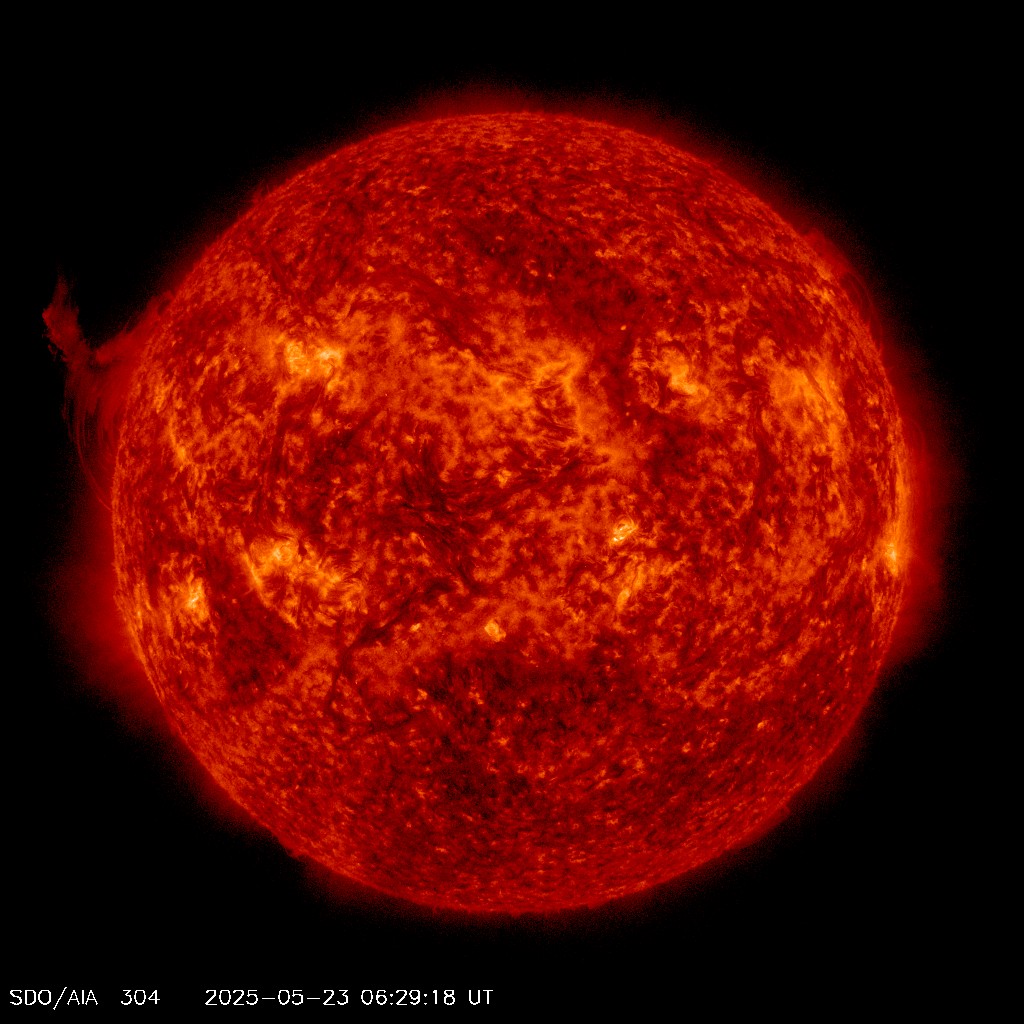
The current image of the Sun at 304 A.
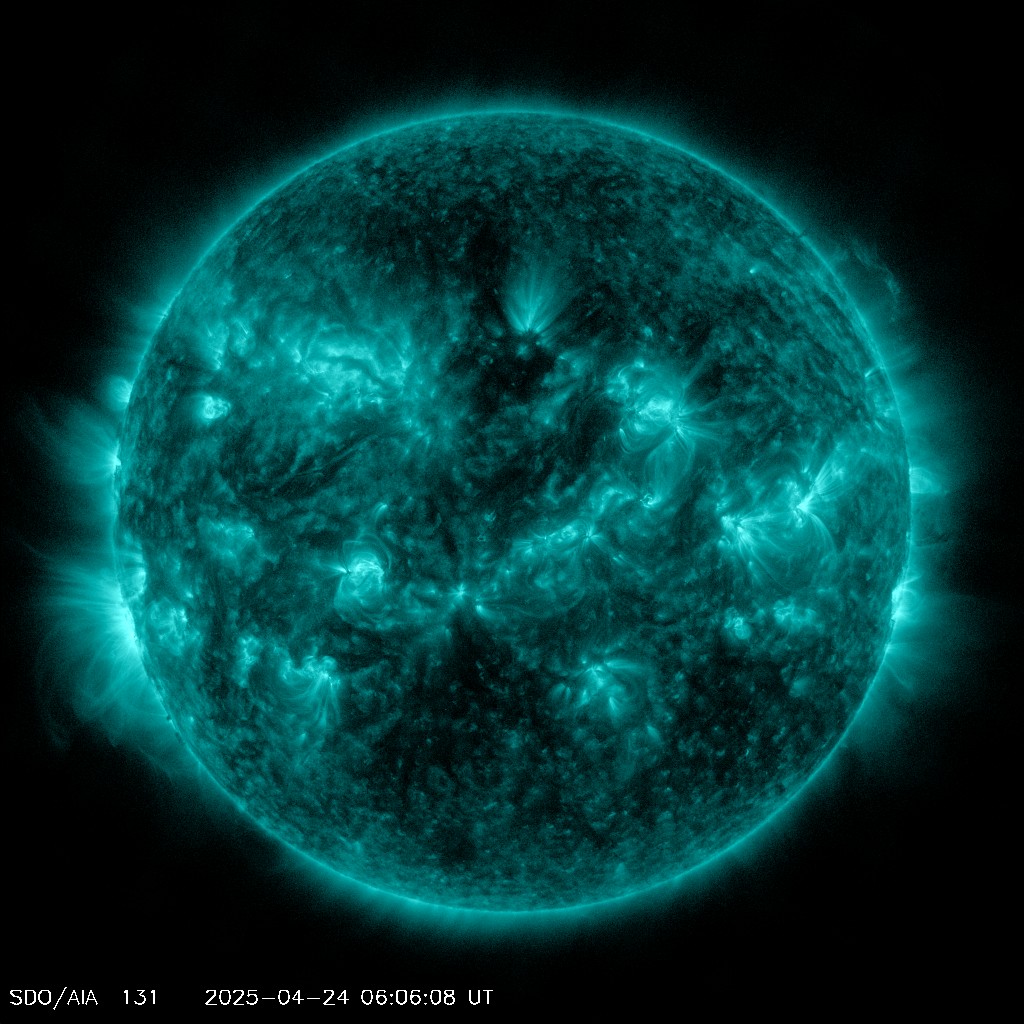
The current image of the Sun at 131 A.
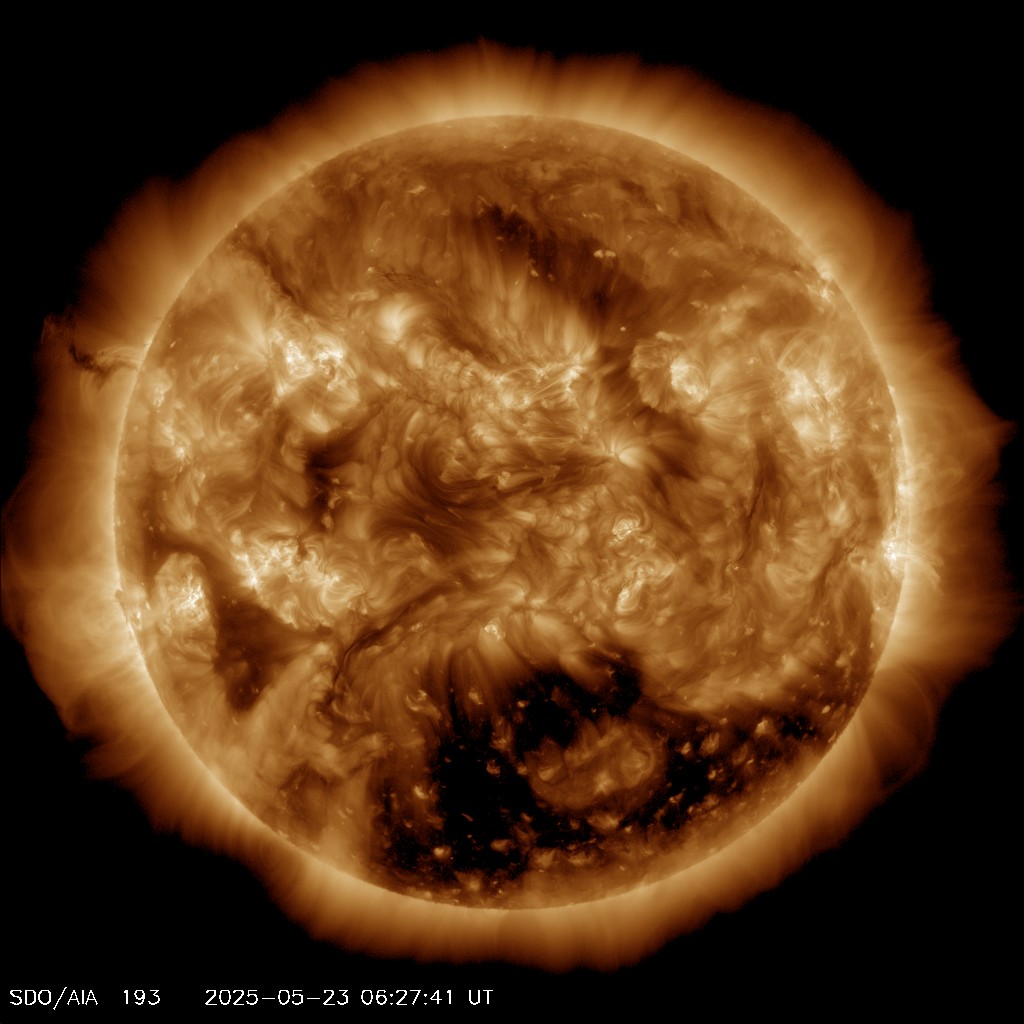
The current image of the Sun at 193 A.
The source of all Space Weather is the Sun and its activities. Therefore the following solar parameters, which act as the drivers for the space weather and immense important for understanding the existing weather and the extent of its potential effects
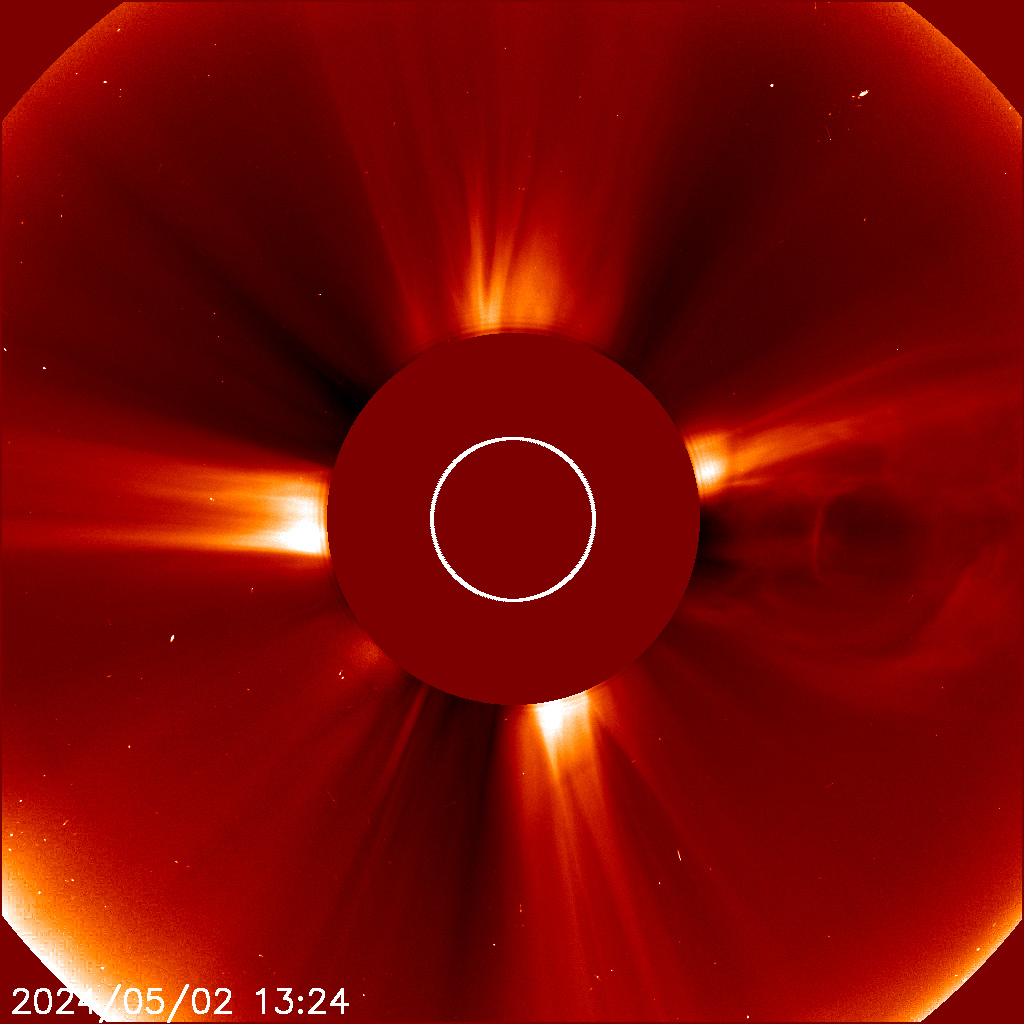
The most recent image of the Solar Corona provided by Coronagraph
SUNSPOT NUMBER
Sunspots are the relatively cooler dark areas on the Sun's surface
+new Time())
+new Time())
F10.7
This is the total solar flux at the 10.7 cm wavelength
+new Time())
+new Time())
The following parameters represent the particle or wave emissions. They can directly affect the earth's atmosphere and ionosphere from within a few minutes to few hours interval from the time of their occurrences.r daily and weekly values are availavbe in the plots.
SOLAR PROTON FLUX
The amount of energetic particles and radiation emissions from the Sun
+new Time())
- PFU: Proton Flux Unit;
- 1 PFU = 1 proton/ (cm² s sr)
+new Time())
- PFU: Proton Flux Unit;
- 1 PFU = 1 proton/ (cm² s sr)
SOLAR X-RAY FLUX
The amount of energetic particles and radiation emissions from the Sun
+new Time())
X-Ray Flux Unit is W/m^2
X-Ray flux > 10^-4 : Class X flare
+new Time())
X-Ray Flux Unit is W/m^2
X-Ray flux > 10^-4 : Class X flare
SOLAR ELECTRON FLUX
The amount of energetic particles and radiation emissions from the Sun
+new Time())
- EFU: Electron Flux Unit;
- 1 EFU = 1 Electron/ (cm² s sr)
+new Time())
Plots derived are for educational purposes only. spaceweathersci.com bears no responsibility for its correctness.
The solar winds are the perennial flow of charged particles (plasma) emitted from the Sun. These hot plasma fills up the interplanetary space and flow downstream towards the edge of the heliosphere. The wind parameters are measured at a location near to the earth, mostly at the Lagrangian point, L1.
SOLAR WIND VELOCITY
The solar wind flows through interplanetary space with velocities of few hundreds of kmps
+new Time())
+new Time())
SOLAR WIND DENSITY
Solar wind is mostly constituted by Hydrogen ions with varying density
+new Time())
+new Time())
SOLAR WIND TEMPERATURE
Ion temperature of the solar wind particles represents their average kinetic energy
+new Time())
+new Time())
The interplanetary magnetic field fills up the interplanetary space. These magnetic fields have their sources at the Sun and is carried into the interplanetary space by the hot plasma of the solar wind which remians frozen with it. These fields are measured with respect to a geocentric reference frame GSE.
IMF Bz
It is the strength and orientation of Bz that determines the disruption in magnetosphere
+new Time())
+new Time())
IMF Bx
It is the X component of the IMF when measured in GSE reference.
 + new Time())
 + new Time())
IMF By
It is the Y component of the IMF when measured in GSE reference.
 + new Time())
 + new Time())
The derived parameters tells a lot about the behaviour of the Solar Wind. The Parker's angle and clock angle provides the relative orientation of the IMF with respect to the earth and its orbit. The ram pressure reveals the strength of the wind to disrupt the benign magnetospheric nature while the distribution of the fast and slow solar wind let us understand the dominant region of the sun that emits the wind.
PARKER'S AND CLOCK ANGLES
The Parkers angle is the angle made by the solar with the earth's orbit.
 + new Time())
 + new Time())
RAM PRESSURE
Ram pressure is the thrusht provided by the solar wind on the magnetospheric surface.
+new Time())
+new Time())
FAST/SLOW WIND DISTRIBUTION
Slow and fast winds are dominant during high and low activity periods respectively
+new Time())
Plots derived are for educational purposes only. spaceweathersci.com bears no responsibility for its correctness.
The magnetosphere acts as a shield that rpotects Earth from the disruptions of the solar wind. However, the magnetospheric features change with the variation of the solar wind emitted from the Sun. Here we present the most salient features of the magnetosphere that are influenced by the impinging solar wind and the associated IMF.
MAGNETOSPHERIC RADIUS
The radial periphery of the magnetosphere measured in Re.
 + new Time())
POLAR CAP POTENTIAL
The electric potential developed across the polar cap due to magnetospheric convection
 + new Time())
 + new Time())
CLOCK ANGLE
Although clock angle is an IMF parameter, it determines many magnetospheric conditions
+new Time())
+new Time())
There are different states of the geomagnetic fields which are determined by various direct and proxy indices. These indices are determined from measurements done on ground or obtained through various models.
Ae
Although Ae is an ionospheric current, it reveals various magnetospheric conditions
 + new Time())
PLASMA SHEET STATE
The Plasma sheet state defines various factors including the ring current formation
 + new Time())
 + new Time())
GEOMAGNETIC FIELDS
These are the magnetometers data that represents the North geomagnetic fields
 + new Time())
 + new Time())
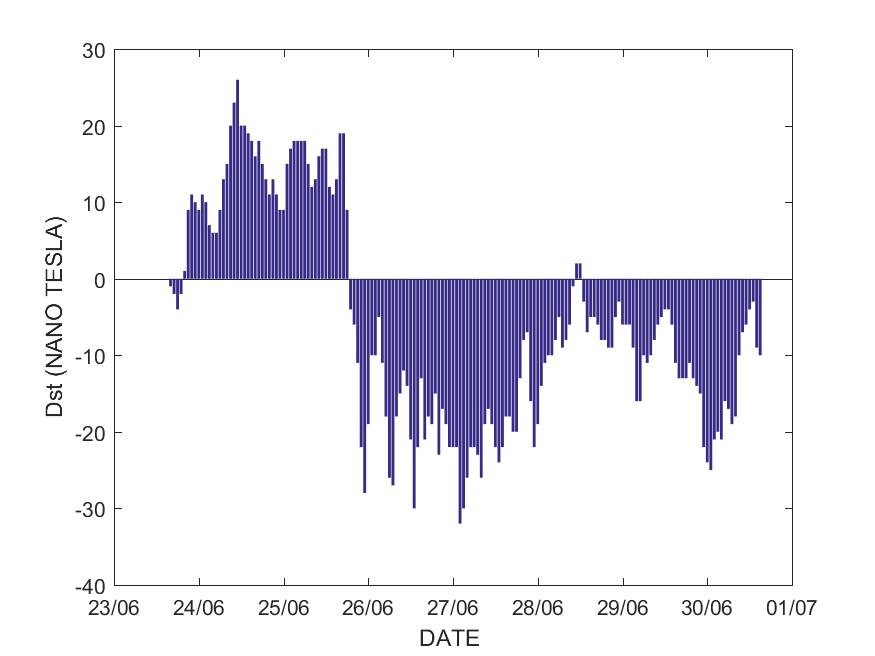
The near-surface geomagnetic fields undergo severe perturbation when space weather event affects the magnetosphere and its elements. This inturn alters the behaviour of the ionosphere and results in geomagnetic storm and substorms.
Dst
Dst is the depreciation of northward geomagnetic field from the nominal value
+new Time())
+new Time())
Ap
Ap index is the global average of deviations of the midlatitude magnetic field in linear scale
 + new Time())
 + new Time())
Kp
Kp index is the global average of deviations of the midlatitude magnetic field in log scale
 + new Time())
 + new Time())
Plots derived are for educational purposes only. spaceweathersci.com bears no responsibility for its correctness.
Important: Plots are derived at spaceweathersci.com from data available at SWPC. These are for educational purpose only and the values may contain errors.
Last Updated at:
"Courtesy of NASA/SDO and the AIA, EVE, and HMI science teams."
Address
B301 Harsh Icon
Ahmedabad, Gujarat
INDIA
Contact Us
info@spaceweathersci.com